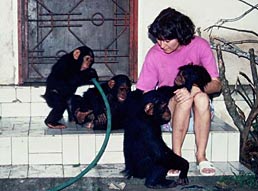
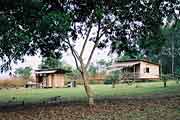
In 1989, Aliette JAMART, a young Frenchwoman living in Pointe Noire in the Republic of
Congo, decided to help the chimpanzees and other primates living under miserable
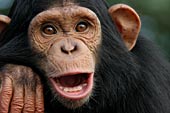
conditions at the zoo in Pointe Noire. She gathered them within her home and stated, "Once you take a chimpanzee in your arms, it becomes impossible to break away...".
|
© Marc ANCRENAZ - HELP CONGO |
|
Soon after, orphans of poaching joined with her number of rescued residents.
But her collection was not enough. She also wanted to curb illegal trafficking and
protect the forest.
So, on 15 February 1990, Aliette JAMART formalized these actions as HELP Congo.
|
|
© Marc ANCRENAZ - HELP CONGO |
|
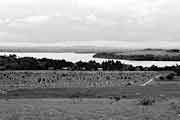
In 1991, the Congolese government provided HELP with three wooded islands on the
Conkouati Lagoon, 180 km north of Pointe-Noire. Thus, was born the Sanctuary
Conkouati.
But the sanctuary had never been a goal for the association. On April 28,
1989, when discovering the zoo and misery for the first time, Aliette JAMART promised
freedom to the chimpanzees
In 1991, upon the transfer of chimpanzees from Pointe-Noire onto the islands, the search began for a release site. The Triangle site location
was discovered in the following months.
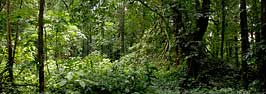
In November of 1996, five chimpanzees were released to the Triangle, a forested area
within the Conkouati-Douli National Park, provided by the Congolese government. This
was later deemed as the first successful release of chimpanzees in their natural habitat
ever made.
|
 © Stéphanie MENG-ZIRILLI - HELP CONGO
 |
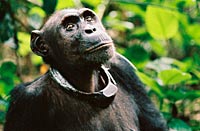
Since 1998, new releases take place regularly and reintroduced chimpanzees are radiocollared
and monitored daily.
Since 2000, HELP Congo has developed other programs :
- Environmental education
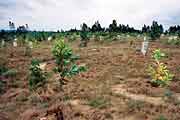
- Creation of a pilot plantation
- Scientific expeditions of primate habitats |
|
| |
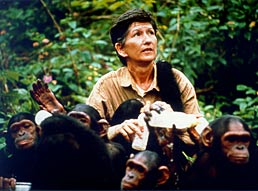
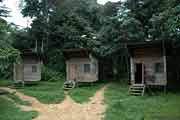
In 2004, Aliette Jamart created the "bivouac" site, under the principle that very young
chimpanzees are placed directly into the forest for quick adaptation to their future
home, but with a human presence for feeding and physical security.
|
|